Internal
 Online courses
 Local: Preuniversity courses
 WebMail
 Repository
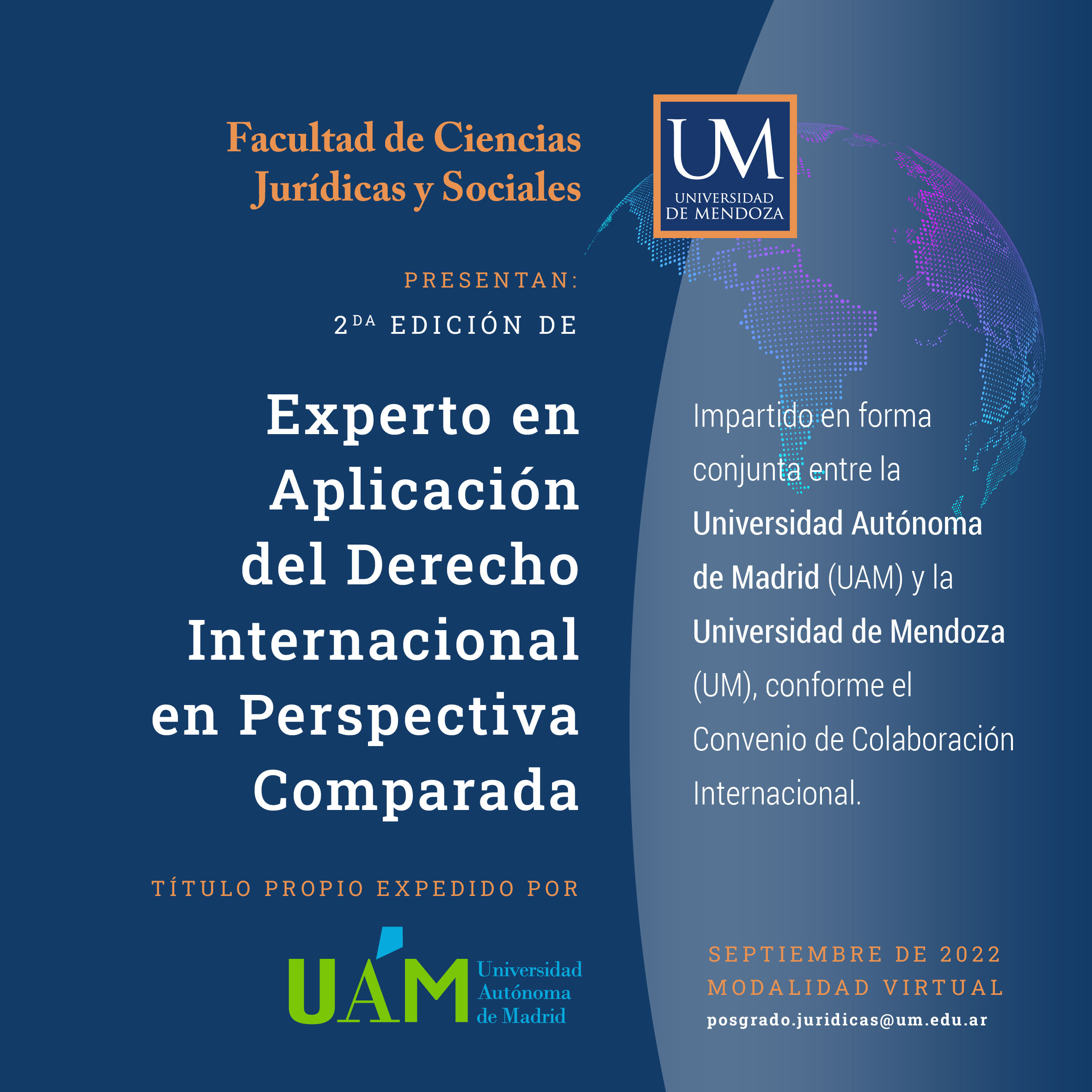
Expert in the application of international law from a comparative perspective UAM-UM (completed)
Presentation
The Postgraduate Studies and Continuing Education Commission of the Universidad Autónoma de Madrid, in its session of February 8, 2022, approved the renewal of this Own Title for the academic year 2022/23. By Rectorate Resolution No. 108, of June 24, 2022, the authorities of the Universidad de Mendoza authorized the implementation of the second edition.
The purpose of the Expert is to ensure a set of advanced conceptual, theoretical and practical tools, aimed at understanding the double dimension that International Law has in two spheres: the external, but also the internal. Thus, the Law of foreign relations offers a valuable framework of analysis to reflect on the application of International Law to the interior –in this case– of the Argentine legal system.
The second discipline that provides the theoretical framework for this research is Comparative International Law, which, although it shares some approaches and starting points with the Law of Foreign Relations, is not completely identified. This part of considering that, although international law is characterized by its claim to universality and uniformity, the way in which each State receives it and -above all- applies it, is very diverse. The purpose of Comparative International Law consists, then, in identifying, analyzing and explaining the similarities and differences in the way in which the legal systems of the different States interpret, apply and approach International Law. Adopting a comparative law approach, we intend to analyze to what extent and how international law is applied in Argentina, as well as in other places in the Ibero-American region, and the influence of foreign relations law on this process.
For these reasons, this Expert is undoubtedly considered a valuable training tool for professionals from different disciplines.
Authorities
Academic direction: Carlos Espósito Massicci, Professor, Department of Public Law and Legal Philosophy, School of Law, Universidad Autónoma de Madrid
Academic coordination: Mgter. Georgina Alejandra Guardatti – Mgter. Ignacio Perotti Pinciroli
Academic secretary: Dr. Maria Valentina Erice
Administrative secretary: Mgter. Georgina Alejandra Guardatti
Teaching Body
Faculty, UAM Law School
- Carlos Esposito Massicci
- Cristina Izquierdo Sans
- Javier Diez-Hochleitner
- Maria Garcia Casas
- Rosa Fernandez Egea
- Soledad Torrecuadrada Garcia-Lozano
- Vanesa Menendez Montero
- Ignacio Perotti Pinciroli
Faculty, School of Law and Social Sciences UM
- Adriano Spedaletti
- Aida kemelmajer
- Alejandro celi
- Alejandro Perez Hualde
- Dante vega
- Eduardo Baistrocchi
- Facundo Diaz Araujo
- Fernando Bermudez
- Georgina Alejandra Guardatti
- Jorge Agustin Vicchi
- Juan Ignacio Perez Curci
- Maria Cristina Ale
- Maria Gabriela Ábalos
- Maria Valentina Erice
- Matthew Bermejo
- Paula Quiroga
- Silvina Furlotti
External teaching staff
- Alexander Perotti, Universidad Austral
- Ana Maria Moore, Universidad de Chile
- Andres Rousset Siri, Universidad Nacional de Cuyo
- Christian Sommer, Universidad Nacional de Córdoba
- Diego Washed, Universidad Nacional de Cuyo
- Eduardo Baistrocchi, Universidad Torcuato Di Tella /London School of Economics
- Emiliano Buís, Universidad de Buenos Aires
- Eulalia Petit, Sevilla University
- Fabian Salvioli, National University of La Plata
- Fernando Arlettaz, University of Zaragoza
- Frida Armas Pfirter, Universidad de Buenos Aires
- Gabriel Botti, Universidad de Buenos Aires
- Gabriel Valladares, National University of La Plata
- Javier Roldan Barbero, University of Granada
- Leopoldo Godio, Universidad de Buenos Aires
- Marcelo Joyful, Universidad de Buenos Aires
- Monica Pinto, Universidad de Buenos Aires
- Nahuel Maisley, Universidad de Buenos Aires
- Natalie Lutherstein, Universidad de Buenos Aires
- Ricardo Abello-Galvis, Rosario University
- Richard Arredondo, Universidad de Buenos Aires
- Roberto Gargarella pointed out, Universidad Torcuato Di Tella
- Sebastian Elijah, Universidad de San Andrés
- Sergio Garcia Ramirez, Autonomous University of Mexico
- Silvina Baron Knoll, Universidad Nacional de Cuyo
- Silvina Gonzalez Napolitano Universidad de Buenos Aires
- Victor Abramovich, Universidad de Lanús
Objectives
The object of the Expert includes the analysis of international law in light of its development and application in domestic legal systems from a comparative law perspective.
This object has been a constant in international law courses to the extent that practically all programs on this subject include some kind of explanation on the relationship between international law and domestic law.
This own study goes much further in its aspirations, because it offers the possibility of understanding the interaction between international law and domestic law in a novel way, adopting the perspective of the domestic law of foreign relations, which not only incorporates normative analysis multilevel –local, national, regional, international–, but also offers the opportunity to examine the norms and practices of national law that interact with international law from an internal point of view, thus allowing a rich and novel approach in itself itself and in the field of comparative international law.
In this way, the Expert, without necessarily entering into a contradiction with them, departs to a certain extent from the traditional theories on the relationship between international law and domestic law, adopting a perspective that allows thinking about national public law, especially in constitutional law, in relation to international law, opening new possible ways of interpreting the classic themes of the matter and perhaps discovering new possibilities for the development of internationally necessary domestic law.
Curriculum
MODULE I
- The application of International Human Rights Law in Argentine and Comparative Law
After the restoration of democracy in 1983, Argentine law underwent an extraordinary transformation incorporating international human rights law, which reached its peak in the 1994 constitutional reform. This first module subject is dedicated to the analysis of the meaning of human rights. incorporation of human rights in the Argentine legal system, its particularities, as well as its scope, hierarchy and effectiveness today. Likewise, emphasis will be placed on reasoning this internationalization process from a comparative perspective, both from the Latin American perspective and from other latitudes (European Law, Anglo-Saxon Law, etc.).
- Latin American Constitutional Law and International Law
The course analyzes the relationship of international law, especially international human rights law, with Latin American and Argentine constitutionalism. What are the characteristics of Latin American constitutionalism? What is your relationship with international (human rights) law? Today there is even talk of a «Latin American transformative constitutionalism» –As A. Von Bogdandy calls it–, where the organs of the Inter-American Human Rights System have played a fundamental role, along with the American States themselves and the various social actors. Some nuances of this process are of great relevance today, in particular from the criticisms that have been made on some aspects of this process.
- International Law, Argentine Criminal Law and Comparative
International law has also had a decisive impact on Argentine criminal law. This incidence has been evidenced with greater intensity in the investigation and prosecution of crimes against humanity. However, international norms and standards have also altered other axes of the criminal field, such as crimes related to money laundering and corruption, preventive detention or criminal procedural regulations. This subject will offer a detailed explanation and analysis of the impact of international law on Argentine criminal law, and its formal and substantive legal relevance.
MODULE2nd
- Integration Law, International Investment Law and Law of the Sea in Argentine Law in Comparative Perspective
This subject is dedicated, first of all, to the study of regional integration law as autonomous and Argentine law, in a broad sense. The topic analyzes how the multilevel theory of human rights protection works, as well as the evolution of national law due to or in relation to the right of regional integration. On the other hand, international investment law has become in recent years a clear protagonist of public international law. The norms and practice of Argentine law have been crucial to understanding this evolution and its current characteristics. In this topic, investment law will be studied from a national perspective, with special emphasis on investment arbitrations and their implementation in Argentina. Likewise, Argentine Law has numerous legal norms that regulate the Law of the Sea, which are also analyzed in this subject, when studying the norms, their particularities and correspondence with the International Law of the Sea.
- Other areas of international law and its implementation in Argentine and comparative law
This last subject examines, first, the impact of international law on Argentine administrative law. In this sense, for some decades global administrative law has been studied as a dimension of the matter. This topic addresses national administrative law from the perspective of international law, incorporating the discussion on the postulates of global administrative law. In the substantive aspects, special attention will be paid to issues related to the protection of the environment. On the other hand, tax law has traditionally been a fundamentally domestic law, but its international dimension has had a very relevant development in recent years. In this topic, the current state of international tax law and its implementation in Argentine law will be studied. Finally, the application of international humanitarian law in Argentina will also be addressed, as well as the regime of jurisdictional immunities and Diplomatic Law in Argentine and comparative law.
FINAL WORK OF THE TITLE
The Final Work of the Expert Title will be a written work that will have as an objective that the student undertakes a research on some of the topics that are developed during the classes.
Recipients
The Expert is aimed at people with a previous university degree and advanced students (with conditional admission) from different disciplines, especially those related to Law, International Relations and related degree courses.
Specific admission requirements
To be admitted to the Expert it is necessary to be a graduate, graduate or advanced student in:
- Bachelor of Laws or Bachelor of Laws,
- Political Sciences,
- International relations,
- Business Administration
- Other related degree courses, provided that the acquisition of basic prior curricular skills in International Law can be demonstrated.
- Graduates of the equivalent degree courses in foreign educational centers may also be admitted (without prior homologation of the degree being necessary).
advanced students
Advanced students who have not completed their undergraduate studies will be able to access the Expert with conditional admission, in accordance with the new UAM regulations. Due to the above, they must finish their degree in the course in which they finish the Expert. If this is not the case, they will not be entitled to the Expert Diploma even if they have passed the subjects. In case of doubt, consult the Postgraduate and Continuing Education Department of our School.
Selection criteria
- Academic record in Bachelor's / Bachelor's degree (weighting: up to 50%)
- Accredited knowledge of languages (up to 10%)
- University degrees in addition to the degree (up to 10%)
- Previous professional experience (up to 10%)
- Admission to other postgraduate programs at national or foreign universities (up to 10%)
- Other curricular merits (up to 10%)
The Academic Directorate, made up of members of the two Universities, will accept the application or not, respecting in any case the equality of criteria for access.
The UM will notify the selected students of their admission and they must complete the necessary procedures for their enrollment within the established deadlines.
Certification
The student enrolled in the Expert study that meets the necessary requirements and passes the established tests and evaluation systems, may opt to obtain the Expert Diploma in the application of International Law in comparative perspective.
The Autonomous University of Madrid is responsible for the issuance, registration, distribution and custody of the Expert Diplomas, as it is a UAM-specific degree, which will be processed at the request of the Study Director.
Tariffed Activity – Scholarships
The Expert is charged for the purpose of guaranteeing the financing of his activities. The amounts of said contributions will be approved by the competent bodies of both institutions. The amount of the fees does not include the costs of issuing the Expert Diploma by the UAM.
The student's tariff obligations with the School start from the moment of enrollment and only end when the student completes the Expert Degree or when he/she decides to suspend his/her studies. In the event that the student decides to drop out after their registration, they must inform the Postgraduate and Continuing Education Department by means of a note expressing their decision. Otherwise, he continues to be a student at the Universidad de Mendoza with the consequent charge of the tariffs that accrue from then on and until the date on which he has effectively communicated his resignation.
Universidad de Mendoza will recognize the following modalities of tariff reductions:
- From an Institution to a Student: the applicant may particularly request financial support to complete the Expert Degree, from Institutions that they consider relevant. These Institutions will be considered "SPONSORS" of the student(s), if they are legally constituted. The commitment to pay the tariff set by the Universidad de Mendoza It will be between the student and that sponsoring Institution, and, in the event that the latter does not comply with the corresponding payment obligations, the student will assume the payment of the debt and the readjustments that it may have.
- From one institution to the Universidad de Mendoza: In the case of legally constituted Institutions that are interested in the participation of their personnel in the Title of Expert and that would like to officially register, they may do so if they assume the commitment to take charge of the fee and readjustment that corresponds to that or those students. The granting of tariff reductions to organizations and companies may be foreseen based on the number of applicants they incorporate, as agreed by current regulations.
- From Universidad de Mendoza to the teaching staff of the Undergraduate and Postgraduate Degree Courses: the Universidad de Mendoza may grant up to half (1/2) scholarship to the members of its teaching staff to carry out the corresponding Expert Title within the framework of the Policy for the improvement of the School's teaching staff.
- From Universidad de Mendoza to the graduate with a degree awarded by the same or to the advanced students of the same: the Universidad de Mendoza may grant up to half (1/2) scholarship to professional graduates and (1/4) advanced students of the Universidad de Mendoza.
- From Universidad de Mendoza who has economic impossibility or other special circumstances. The Diplomas You can award scholarships to your students according to budget possibilities. The number of scholarships cannot exceed 10% of the total number of registered.
In all cases in which a scholarship has been awarded, the fee for the Expert degree will be exempt from this benefit.
Recognized scholarships: 12 partial scholarships. For its concession, the following will be taken into account:
- Academic record (up to 50%)
- Unemployment situation (up to 25%)
- Socioeconomic status (up to 25%)
Queries: postgraduate.juridicas@um.edu.ar
Collaborating Universities
The Expert study is taught jointly between the Universidad Autónoma de Madrid (UAM) and the Universidad de Mendoza (UM)
La UAM It has been configured, since 1968 and throughout the years, as a benchmark institution at a national and international level, occupying relevant positions in the rankings of academic and research excellence, employability and sustainability. A public university with a strong commitment to the social, cultural and economic environment, as well as a declared international vocation. The UAM is one of the universities integrated in Civic, a European Civic University, one of the first pan-European campuses promoted by the European Commission.
The UAM School of Law was created in 1970 and, thanks to the prestige of its founders, it soon became one of the most important Law Schools in Spain and one of the best in Europe. Located in a modern building, it has one of the best Libraries of its specialty. The School has a range of degrees that are fully adapted to the European higher education system with four degree studies: Degree in Law, Degree in Political Science and Public Management, Double Degree in Law and in Political Science and Public Management and Double Degree in Law and in Business Administration and Management (which is taught together with the School of Economic and Business Sciences). They are joined by international degrees to study the Degree in Law together with the universities of Strasbourg and Maastricht and the Degree in Political Science in collaboration with the Institute of Political Studies of Bordeaux. It also has a wide range of official postgraduate studies in both Law and Political Science.
The School of Law is characterized by having an intense academic life aimed at promoting a fairer, more equitable, more participatory and inclusive society. Gender equality, respect for difference, diversity and multiculturalism, solidarity and cooperation and its involvement with culture and the sensitivity that it has always had with the problems that concern citizens, have been traits that have always honored our School.
La UM It is a Higher Education institution that has established itself throughout its 60 years as the privately managed university with the most extensive and prestigious educational trajectory in the region. Since 1960, it has been strongly committed to achieving academic quality, scientific research and community service.
It is important to highlight that the UM has a vision and mission based on the integral formation of the human being, respect for Human Rights, Democracy and the Environment. It has a large Library, access to Online Chairs, Student Guidance Service, language courses, social and sports activities, and invites programs aimed at promoting the mobility and exchange of students, teachers and researchers through agreements with more than 300 Universities.
The UM School of Law and Social Sciences is the first Law School in the province and also has a campus in the City of San Rafael since 1998, which offers Law, Notary and Procurement degree courses, as well as various postgraduate degree courses – Doctorate, Masters and Specializations-, and Continuous Training activities – Diplomas, Courses, among others-, in a framework of excellence academic, equality, freedom of thought and research and intellectual honesty.
Its professors, with a marked teaching vocation, provide quality comprehensive teaching and constant personalized advice for the best academic performance of their students. They promote an adequate field of interaction between those who are interested in learning and those who wish to transmit their knowledge in order to achieve a solid legal training, which will allow them to analyze problems and make decisions for a solution depending on the role they play as lawyers, notaries , attorneys, business advisers, judges, public officials or legislators, etc.
Its graduates bear witness to its prestige, reaching a prominent place in professional performance, whether in the public or private sphere, both locally, nationally and internationally.
In accordance with Resolutions No. 2020-632 and 2020-543, issued by CONEAU, it was arranged to accredit the Law degree course for 6 years, both in the Central and San Rafael from the School of Law and Social Sciences of the Universidad de Mendoza.
Academic direction: Carlos Espósito Massicci, Professor, Department of Public Law and Legal Philosophy, School of Law, Universidad Autónoma de Madrid
Academic coordination: Mgter. Georgina Alejandra Guardatti – Mgter. Ignacio Perotti Pinciroli
Academic secretary: Dr. Maria Valentina Erice
Administrative secretary: Mgter. Georgina Alejandra Guardatti
Faculty, UAM Law School
- Carlos Esposito Massicci
- Cristina Izquierdo Sans
- Javier Diez-Hochleitner
- Maria Garcia Casas
- Rosa Fernandez Egea
- Soledad Torrecuadrada Garcia-Lozano
- Vanesa Menendez Montero
- Ignacio Perotti Pinciroli
Faculty, School of Law and Social Sciences UM
- Adriano Spedaletti
- Aida kemelmajer
- Alejandro celi
- Alejandro Perez Hualde
- Dante vega
- Eduardo Baistrocchi
- Facundo Diaz Araujo
- Fernando Bermudez
- Georgina Alejandra Guardatti
- Jorge Agustin Vicchi
- Juan Ignacio Perez Curci
- Maria Cristina Ale
- Maria Gabriela Ábalos
- Maria Valentina Erice
- Matthew Bermejo
- Paula Quiroga
- Silvina Furlotti
External teaching staff
- Alexander Perotti, Universidad Austral
- Ana Maria Moore, Universidad de Chile
- Andres Rousset Siri, Universidad Nacional de Cuyo
- Christian Sommer, Universidad Nacional de Córdoba
- Diego Washed, Universidad Nacional de Cuyo
- Eduardo Baistrocchi, Universidad Torcuato Di Tella /London School of Economics
- Emiliano Buís, Universidad de Buenos Aires
- Eulalia Petit, Sevilla University
- Fabian Salvioli, National University of La Plata
- Fernando Arlettaz, University of Zaragoza
- Frida Armas Pfirter, Universidad de Buenos Aires
- Gabriel Botti, Universidad de Buenos Aires
- Gabriel Valladares, National University of La Plata
- Javier Roldan Barbero, University of Granada
- Leopoldo Godio, Universidad de Buenos Aires
- Marcelo Joyful, Universidad de Buenos Aires
- Monica Pinto, Universidad de Buenos Aires
- Nahuel Maisley, Universidad de Buenos Aires
- Natalie Lutherstein, Universidad de Buenos Aires
- Ricardo Abello-Galvis, Rosario University
- Richard Arredondo, Universidad de Buenos Aires
- Roberto Gargarella pointed out, Universidad Torcuato Di Tella
- Sebastian Elijah, Universidad de San Andrés
- Sergio Garcia Ramirez, Autonomous University of Mexico
- Silvina Baron Knoll, Universidad Nacional de Cuyo
- Silvina Gonzalez Napolitano Universidad de Buenos Aires
- Victor Abramovich, Universidad de Lanús
The object of the Expert includes the analysis of international law in light of its development and application in domestic legal systems from a comparative law perspective.
This object has been a constant in international law courses to the extent that practically all programs on this subject include some kind of explanation on the relationship between international law and domestic law.
This own study goes much further in its aspirations, because it offers the possibility of understanding the interaction between international law and domestic law in a novel way, adopting the perspective of the domestic law of foreign relations, which not only incorporates normative analysis multilevel –local, national, regional, international–, but also offers the opportunity to examine the norms and practices of national law that interact with international law from an internal point of view, thus allowing a rich and novel approach in itself itself and in the field of comparative international law.
In this way, the Expert, without necessarily entering into a contradiction with them, departs to a certain extent from the traditional theories on the relationship between international law and domestic law, adopting a perspective that allows thinking about national public law, especially in constitutional law, in relation to international law, opening new possible ways of interpreting the classic themes of the matter and perhaps discovering new possibilities for the development of internationally necessary domestic law.
MODULE I
- The application of International Human Rights Law in Argentine and Comparative Law
After the restoration of democracy in 1983, Argentine law underwent an extraordinary transformation incorporating international human rights law, which reached its peak in the 1994 constitutional reform. This first module subject is dedicated to the analysis of the meaning of human rights. incorporation of human rights in the Argentine legal system, its particularities, as well as its scope, hierarchy and effectiveness today. Likewise, emphasis will be placed on reasoning this internationalization process from a comparative perspective, both from the Latin American perspective and from other latitudes (European Law, Anglo-Saxon Law, etc.).
- Latin American Constitutional Law and International Law
The course analyzes the relationship of international law, especially international human rights law, with Latin American and Argentine constitutionalism. What are the characteristics of Latin American constitutionalism? What is your relationship with international (human rights) law? Today there is even talk of a «Latin American transformative constitutionalism» –As A. Von Bogdandy calls it–, where the organs of the Inter-American Human Rights System have played a fundamental role, along with the American States themselves and the various social actors. Some nuances of this process are of great relevance today, in particular from the criticisms that have been made on some aspects of this process.
- International Law, Argentine Criminal Law and Comparative
International law has also had a decisive impact on Argentine criminal law. This incidence has been evidenced with greater intensity in the investigation and prosecution of crimes against humanity. However, international norms and standards have also altered other axes of the criminal field, such as crimes related to money laundering and corruption, preventive detention or criminal procedural regulations. This subject will offer a detailed explanation and analysis of the impact of international law on Argentine criminal law, and its formal and substantive legal relevance.
MODULE2nd
- Integration Law, International Investment Law and Law of the Sea in Argentine Law in Comparative Perspective
This subject is dedicated, first of all, to the study of regional integration law as autonomous and Argentine law, in a broad sense. The topic analyzes how the multilevel theory of human rights protection works, as well as the evolution of national law due to or in relation to the right of regional integration. On the other hand, international investment law has become in recent years a clear protagonist of public international law. The norms and practice of Argentine law have been crucial to understanding this evolution and its current characteristics. In this topic, investment law will be studied from a national perspective, with special emphasis on investment arbitrations and their implementation in Argentina. Likewise, Argentine Law has numerous legal norms that regulate the Law of the Sea, which are also analyzed in this subject, when studying the norms, their particularities and correspondence with the International Law of the Sea.
- Other areas of international law and its implementation in Argentine and comparative law
This last subject examines, first, the impact of international law on Argentine administrative law. In this sense, for some decades global administrative law has been studied as a dimension of the matter. This topic addresses national administrative law from the perspective of international law, incorporating the discussion on the postulates of global administrative law. In the substantive aspects, special attention will be paid to issues related to the protection of the environment. On the other hand, tax law has traditionally been a fundamentally domestic law, but its international dimension has had a very relevant development in recent years. In this topic, the current state of international tax law and its implementation in Argentine law will be studied. Finally, the application of international humanitarian law in Argentina will also be addressed, as well as the regime of jurisdictional immunities and Diplomatic Law in Argentine and comparative law.
FINAL WORK OF THE TITLE
The Final Work of the Expert Title will be a written work that will have as an objective that the student undertakes a research on some of the topics that are developed during the classes.
The Expert is aimed at people with a previous university degree and advanced students (with conditional admission) from different disciplines, especially those related to Law, International Relations and related degree courses.
Specific admission requirements
To be admitted to the Expert it is necessary to be a graduate, graduate or advanced student in:
- Bachelor of Laws or Bachelor of Laws,
- Political Sciences,
- International relations,
- Business Administration
- Other related degree courses, provided that the acquisition of basic prior curricular skills in International Law can be demonstrated.
- Graduates of the equivalent degree courses in foreign educational centers may also be admitted (without prior homologation of the degree being necessary).
advanced students
Advanced students who have not completed their undergraduate studies will be able to access the Expert with conditional admission, in accordance with the new UAM regulations. Due to the above, they must finish their degree in the course in which they finish the Expert. If this is not the case, they will not be entitled to the Expert Diploma even if they have passed the subjects. In case of doubt, consult the Postgraduate and Continuing Education Department of our School.
Selection criteria
- Academic record in Bachelor's / Bachelor's degree (weighting: up to 50%)
- Accredited knowledge of languages (up to 10%)
- University degrees in addition to the degree (up to 10%)
- Previous professional experience (up to 10%)
- Admission to other postgraduate programs at national or foreign universities (up to 10%)
- Other curricular merits (up to 10%)
The Academic Directorate, made up of members of the two Universities, will accept the application or not, respecting in any case the equality of criteria for access.
The UM will notify the selected students of their admission and they must complete the necessary procedures for their enrollment within the established deadlines.
The student enrolled in the Expert study that meets the necessary requirements and passes the established tests and evaluation systems, may opt to obtain the Expert Diploma in the application of International Law in comparative perspective.
The Autonomous University of Madrid is responsible for the issuance, registration, distribution and custody of the Expert Diplomas, as it is a UAM-specific degree, which will be processed at the request of the Study Director.
The Expert is charged for the purpose of guaranteeing the financing of his activities. The amounts of said contributions will be approved by the competent bodies of both institutions. The amount of the fees does not include the costs of issuing the Expert Diploma by the UAM.
The student's tariff obligations with the School start from the moment of enrollment and only end when the student completes the Expert Degree or when he/she decides to suspend his/her studies. In the event that the student decides to drop out after their registration, they must inform the Postgraduate and Continuing Education Department by means of a note expressing their decision. Otherwise, he continues to be a student at the Universidad de Mendoza with the consequent charge of the tariffs that accrue from then on and until the date on which he has effectively communicated his resignation.
Universidad de Mendoza will recognize the following modalities of tariff reductions:
- From an Institution to a Student: the applicant may particularly request financial support to complete the Expert Degree, from Institutions that they consider relevant. These Institutions will be considered "SPONSORS" of the student(s), if they are legally constituted. The commitment to pay the tariff set by the Universidad de Mendoza It will be between the student and that sponsoring Institution, and, in the event that the latter does not comply with the corresponding payment obligations, the student will assume the payment of the debt and the readjustments that it may have.
- From one institution to the Universidad de Mendoza: In the case of legally constituted Institutions that are interested in the participation of their personnel in the Title of Expert and that would like to officially register, they may do so if they assume the commitment to take charge of the fee and readjustment that corresponds to that or those students. The granting of tariff reductions to organizations and companies may be foreseen based on the number of applicants they incorporate, as agreed by current regulations.
- From Universidad de Mendoza to the teaching staff of the Undergraduate and Postgraduate Degree Courses: the Universidad de Mendoza may grant up to half (1/2) scholarship to the members of its teaching staff to carry out the corresponding Expert Title within the framework of the Policy for the improvement of the School's teaching staff.
- From Universidad de Mendoza to the graduate with a degree awarded by the same or to the advanced students of the same: the Universidad de Mendoza may grant up to half (1/2) scholarship to professional graduates and (1/4) advanced students of the Universidad de Mendoza.
- From Universidad de Mendoza who has economic impossibility or other special circumstances. The Diplomas You can award scholarships to your students according to budget possibilities. The number of scholarships cannot exceed 10% of the total number of registered.
In all cases in which a scholarship has been awarded, the fee for the Expert degree will be exempt from this benefit.
Recognized scholarships: 12 partial scholarships. For its concession, the following will be taken into account:
- Academic record (up to 50%)
- Unemployment situation (up to 25%)
- Socioeconomic status (up to 25%)
Queries: postgraduate.juridicas@um.edu.ar
The Expert study is taught jointly between the Universidad Autónoma de Madrid (UAM) and the Universidad de Mendoza (UM)
La UAM It has been configured, since 1968 and throughout the years, as a benchmark institution at a national and international level, occupying relevant positions in the rankings of academic and research excellence, employability and sustainability. A public university with a strong commitment to the social, cultural and economic environment, as well as a declared international vocation. The UAM is one of the universities integrated in Civic, a European Civic University, one of the first pan-European campuses promoted by the European Commission.
The UAM School of Law was created in 1970 and, thanks to the prestige of its founders, it soon became one of the most important Law Schools in Spain and one of the best in Europe. Located in a modern building, it has one of the best Libraries of its specialty. The School has a range of degrees that are fully adapted to the European higher education system with four degree studies: Degree in Law, Degree in Political Science and Public Management, Double Degree in Law and in Political Science and Public Management and Double Degree in Law and in Business Administration and Management (which is taught together with the School of Economic and Business Sciences). They are joined by international degrees to study the Degree in Law together with the universities of Strasbourg and Maastricht and the Degree in Political Science in collaboration with the Institute of Political Studies of Bordeaux. It also has a wide range of official postgraduate studies in both Law and Political Science.
The School of Law is characterized by having an intense academic life aimed at promoting a fairer, more equitable, more participatory and inclusive society. Gender equality, respect for difference, diversity and multiculturalism, solidarity and cooperation and its involvement with culture and the sensitivity that it has always had with the problems that concern citizens, have been traits that have always honored our School.
La UM It is a Higher Education institution that has established itself throughout its 60 years as the privately managed university with the most extensive and prestigious educational trajectory in the region. Since 1960, it has been strongly committed to achieving academic quality, scientific research and community service.
It is important to highlight that the UM has a vision and mission based on the integral formation of the human being, respect for Human Rights, Democracy and the Environment. It has a large Library, access to Online Chairs, Student Guidance Service, language courses, social and sports activities, and invites programs aimed at promoting the mobility and exchange of students, teachers and researchers through agreements with more than 300 Universities.
The UM School of Law and Social Sciences is the first Law School in the province and also has a campus in the City of San Rafael since 1998, which offers Law, Notary and Procurement degree courses, as well as various postgraduate degree courses – Doctorate, Masters and Specializations-, and Continuous Training activities – Diplomas, Courses, among others-, in a framework of excellence academic, equality, freedom of thought and research and intellectual honesty.
Its professors, with a marked teaching vocation, provide quality comprehensive teaching and constant personalized advice for the best academic performance of their students. They promote an adequate field of interaction between those who are interested in learning and those who wish to transmit their knowledge in order to achieve a solid legal training, which will allow them to analyze problems and make decisions for a solution depending on the role they play as lawyers, notaries , attorneys, business advisers, judges, public officials or legislators, etc.
Its graduates bear witness to its prestige, reaching a prominent place in professional performance, whether in the public or private sphere, both locally, nationally and internationally.
In accordance with Resolutions No. 2020-632 and 2020-543, issued by CONEAU, it was arranged to accredit the Law degree course for 6 years, both in the Central and San Rafael from the School of Law and Social Sciences of the Universidad de Mendoza.